
Business Adaptation Strategies to Grow in Uncertain and Evolving Markets
Adapting to change is a strategic necessity, not just a survival tactic. In this article, Xternus shares practical business adaptation strategies to help Spanish SMEs build resilience, boost operational agility, and stay competitive in evolving markets.
Adapting is no longer optional. If you lead a small or mid-sized business, you’ve likely experienced how rapidly changing markets, new technologies, economic shifts, or regulatory changes, can impact your operations. In today's dynamic business landscape, flexibility is essential for survival and long-term growth.
In this article, we outline practical and effective business adaptation strategies to help your company build resilience, improve operational efficiency, and remain competitive, even in unpredictable environments.
What Are Business Adaptation Strategies?
Business adaptation strategies are structured action plans that enable companies to proactively adjust to internal and external changes. Rather than reacting to a crisis, adaptive organizations develop the ability to anticipate disruptions, respond quickly, and evolve continuously.
These strategies may include:
A. Business process digitization
B. Agile methodologies implementation
C. Business model redesign
D. Outsourcing non-core operations (e.g., back office or customer service)
The main goal is to ensure business continuity, maintain competitive advantage, and support sustainable growth over time.
Key Benefits of Business Adaptation
By applying adaptation strategies in your organization, you can achieve:
A. Greater business resilience** during market disruptions B. Improved agility and reduced operational costs through outsourcing and automation C. Smarter decision-making via data-driven analysis and structured processes D. Enhanced talent retention by promoting flexibility and a culture of innovation E. Stronger market positioning, especially in fast-moving sectors like logistics, insurance, fintech, eCommerce or healthcare

Case in point: Many companies that digitalized their back office before the pandemic not only survived the disruption but now lead their market segment.
How to Implement Adaptation Strategies in Your SME
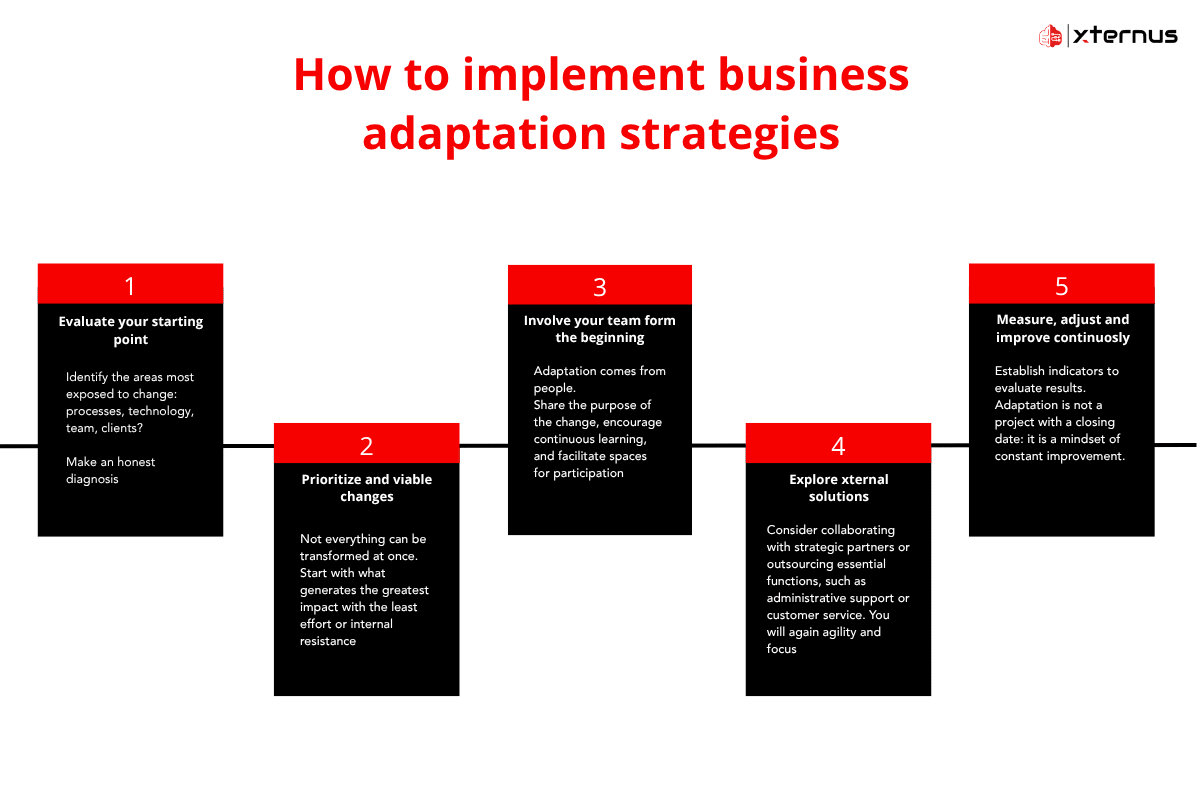
If you want to future-proof your business, follow these key steps:
1)Assess Your Business Readiness: Identify areas most exposed to change, processes, technology, teams, or customer needs. Be honest about your current situation.
2)Prioritize High-Impact, Feasible Changes: Don’t try to change everything at once. Focus on areas with high ROI and low internal resistance.
3)Engage Your Team Early: Resilience starts with people. Communicate clearly, foster continuous learning, and encourage team involvement.
4)Leverage External Support: Consider strategic partnerships or outsourcing essential functions (e.g., administrative tasks, customer support). This frees up time and resources for innovation.
5)Track, Adjust, and Iterate: Establish KPIs to monitor progress. Adaptation is not a one-time effort, it's an ongoing mindset.
👉 Need expert help identifying what to optimize in your operations? Talk to a business process specialist to uncover hidden improvement opportunities tailored to your sector.
Conclusion: Adaptation as a Growth Strategy
Adaptability is no longer just a survival tactic, it’s a competitive strategy. Businesses that cultivate a flexible and future-ready mindset are better positioned to: Compete in volatile markets,
drive sustainable innovation,
achieve long-term success.
Explore How Other SMEs Are Adapting and Growing
Related Capabilities
Related Insights
Freelancers, BPO or Xternus? How to choose the best option for your company
Guide with a comparative table of Freelancers, Traditional BPO and Xternus for efficient outsourcing and strategic control.
Read More →How to apply AI and outsourced process automation without losing the human touch
Learn to automate outsourced processes with AI and flexible talent without losing the human touch.
Read More →Checklist to assess your brokerage’s readiness for a DANA
Assess your brokerage’s readiness for a DANA and improve its operational resilience for a better response capacity.
Read More →How an efficient COO turns dispersion into direction and value
Discover how the most efficient COOs turn operational complexity into measurable growth.
Read More →Checklist of administrative tasks to outsource before expanding your team
Identify which administrative tasks to outsource and free your team to focus on strategy and growth.
Read More →Automation and flexibility to avoid bottlenecks in insurance
Avoid bottlenecks in insurance with automation and flexible teams for faster and more efficient processes.
Read More →Cookie Consent
We use cookies to enhance your browsing experience, serve personalized content, and analyze our traffic. By clicking "Accept All", you consent to our use of cookies. Learn more